Every consultant, every auditor, every sharp-eyed banker will tell you the same thing: watch the numbers. Watch the revenue curve, the burn rate, the receivables aging. They carry their spreadsheets like priests carry scripture — and they will miss the collapse every single time until it is too late to matter.
I don’t read spreadsheets. I read spaces.
In thirty years of walking through the offices, factories, and boardrooms of the men and women whose destiny charts I hold, Master Chi has never once seen a company die in its financials first. The death begins in the physical space — sometimes three years before the first creditor calls, sometimes five. The numbers are only the obituary. The workspace is the illness.
What most people don’t understand about Feng Shui is that it is not decoration philosophy. It is not about lucky colors and bamboo plants on reception desks. Those are toys for people who have money to spend on feeling good. Real Feng Shui is the study of how energy — Chi fortune, the living breath that moves through every built environment — either amplifies or slowly poisons the human beings who inhabit it. A space shapes the cognition and the destiny framework of everyone who works within it. Day by day. Year by year. Invisibly.
When the Chi of a workspace turns — when it begins to stagnate, to compress, to flow in patterns that contradict the ambitions of the people inside — you will not see it in the quarterly report. You will see it in how people stand in the hallway. You will see it in where the CEO chooses to hold his important calls. You will feel it in the quality of silence when you walk through the door.
I have felt that silence in rooms that were still nominally turning a profit. I have walked out of those rooms knowing what the founders did not yet know: that they were already finished.
Let me tell you about a man I’ll call Director Fang.
I met him in Shenzhen in the spring of 2021, introduced through a mutual acquaintance who runs import operations out of Guangzhou. Director Fang was in his mid-forties, well-dressed, a manufacturing operation of about two hundred people producing precision components for the electronics supply chain. He had come to me because his major life cycle — his decade luck — was entering what his BaZi chart showed as a transitional phase, and he wanted guidance on whether to expand or consolidate.
We met at his office on the seventeenth floor of a tower in Nanshan. Decent address. Professional lobby. I remember the receptionist was pleasant and the coffee was good.
And then I walked past reception and into the actual working space, and I knew.
The CEO’s office was at the far end of a long corridor, facing away from the building’s main energy axis. His desk — a heavy, expensive piece — was positioned with his back to the window and his face toward a wall. Behind him, glass: all that rushing urban Chi pouring at his spine hour after hour, scattering his judgment, eroding his capacity to hold still in moments of decision. The conference room was positioned in what should have been the wealth sector of the floor plate, but it was being used as storage — boxes, old equipment, a broken printer that had been there, someone told me, for two years. Nobody had thought to move it. Two years.
The finance team sat in a cluster near the emergency exit. I am not speaking metaphorically when I say this. The people responsible for the money were physically positioned at the point of departure from the building.
I told Director Fang, very plainly, that the layout of his space was in direct conflict with his BaZi chart’s favorable directions — and worse, that the accumulated stagnation in the space spoke to a leadership team that had quietly stopped believing in forward motion. He laughed a little. He said his numbers were fine.
His company began losing major contracts in late 2022. By the middle of 2023 he had let go forty percent of his staff. Last year I heard through the Guangzhou acquaintance that the operation had been absorbed by a competitor at distressed valuation.
The numbers had been “fine” for another eighteen months after I walked through that door. But the bankruptcy had already begun.
This is the truth that high-tier operators understand and low-tier operators will argue with until the bailiff arrives: a company’s physical space is a living record of its leadership’s inner state. The two are inseparable. The space does not cause the decline — it reflects and then accelerates it.
A low-tier founder looks at his office and sees: functional or not functional. Is there a desk? Is there internet? Do clients seem impressed by the lobby? That is the limit of his analysis.
A high-tier operator walks into any business and reads the space the way a doctor reads a patient’s face before the chart is even opened. He notices which walls are bare that shouldn’t be. He notices where the energy pools and where it drains away. He notices whether the person in charge of the whole operation has positioned himself to receive or to defend. These things tell him everything. The spreadsheet confirms what he already knows.
Ask yourself honestly: what does your workspace look like right now? Not the way it looked when you first moved in, filled with purpose and ambition. What does it look like today?
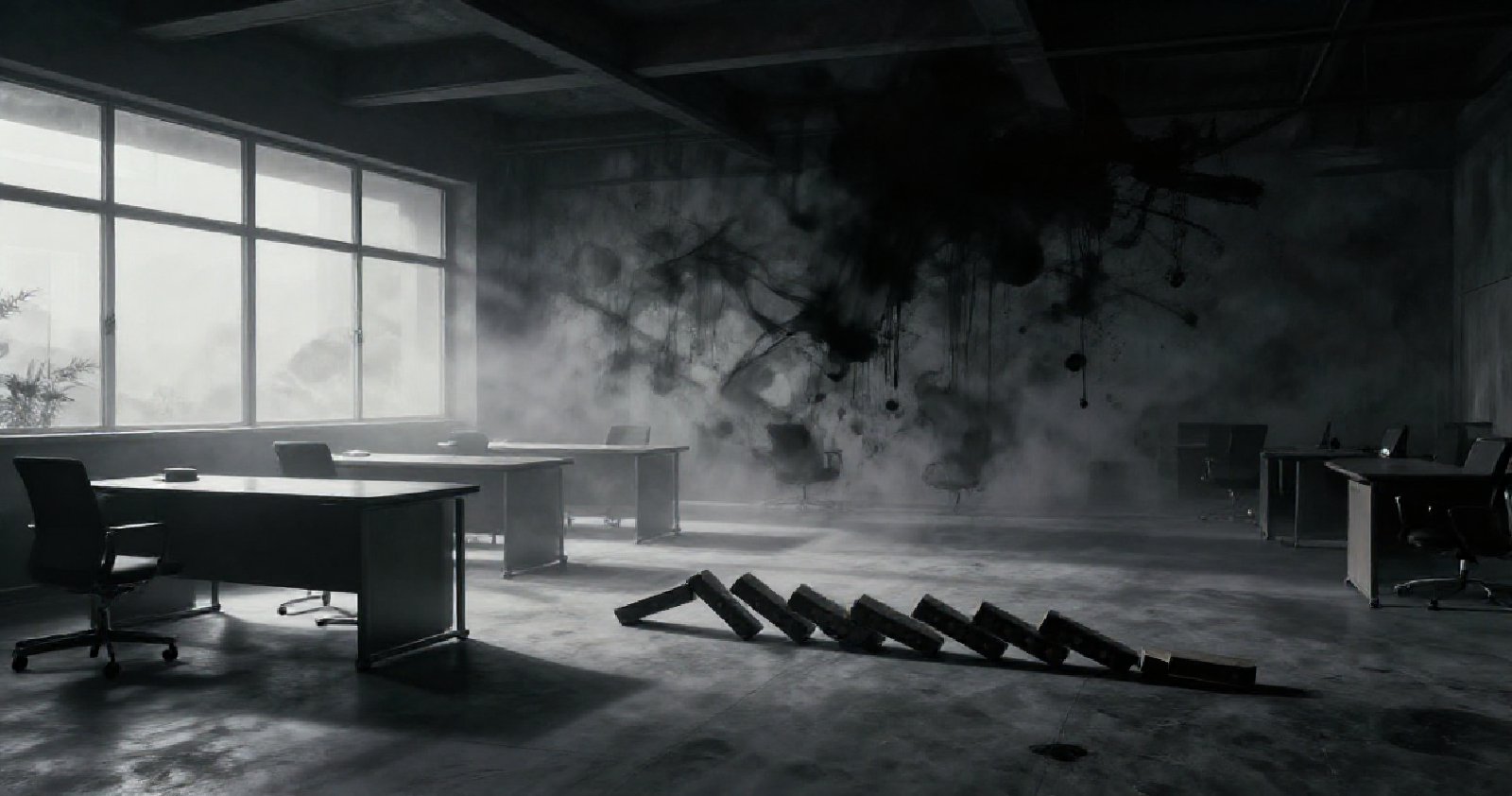
Are there things you’ve been meaning to fix for months? Broken fixtures nobody has bothered to replace? A corner that has become a graveyard of old projects and equipment that “might be useful someday”? A whiteboard with goals from two years ago, half-erased, nobody has wiped clean?
Every one of these is a message. The space is speaking. The question is whether you are listening.
There is a principle that Master Chi has observed consistently across decades of readings: the Chi fortune of a business concentrates most powerfully in the space where its leader actually works and thinks. Not where the leader officially sits. Where he actually spends his most focused hours.
When a founder is in his prime — when his major life cycle is flowing and his destiny framework is aligned — he inhabits his space fully. He fills it. He moves through it with ownership. The physical environment responds to that energy: it stays ordered, purposeful, alive.
When the tide begins to turn — when the major life cycle shifts, when the invisible pressures begin to mount — the founder begins to retreat. Not in any way he would announce or even notice. He starts taking calls in the car. He works from home more than he admits. He eats lunch at his desk not out of focus but out of avoidance. The office begins to feel like a place where problems live rather than a place where power lives.
And so the space is abandoned by its animating force. And an abandoned space accumulates stagnation the way a still pond accumulates algae. Slowly. Completely.
The kingdom whose king no longer walks its halls has already changed masters — even if the throne still bears the old name.
What I am describing is not superstition. It is a pattern so consistent, so repeatable, that I have come to treat it as diagnostic. When a client tells me their business is struggling and I walk into their workspace and find it cold, cluttered, half-abandoned by leadership’s actual presence — I know we are not dealing with a market problem or a product problem. We are dealing with a Chi problem that has already metastasized into every system the business runs on.
I should admit something here.
Master Chi has not always read these signs correctly in his own life. In my earlier years, when my practice was growing and I was more interested in being right than in being wise, I moved my working space twice in three years for reasons of prestige rather than principle. Better address, more impressive setting for client meetings. Both times the work became harder. The noble benefactors — the Gui Ren who appeared in my destiny chart as critical connectors — became harder to reach, harder to hold. Relationships that should have flourished went flat. I told myself it was the economy, the city, the season.
It was the space. I had abandoned the energetic conditions that had allowed me to build the practice in the first place, in favor of performing success for an audience that didn’t matter.
It cost me nearly four years to rebuild what I had spent ten years creating. I do not recommend the lesson.
What the collapse looks like before anyone calls it a collapse:
The receptionist stops smiling. Not because she was told to stop. Because the energy she is paid to project forward has nothing behind it. She can feel the vacuum at the center of the building and her face knows it before her mind does.
The meeting rooms begin to fill for the wrong reasons — damage control, blame distribution, anxious regroupings that produce slide decks and no decisions. A company that is genuinely moving forward rarely meets this much. It acts.
The plants die. This sounds trivial. It is not. An office in which living things cannot be maintained is an office whose occupants have lost the spare attention required to sustain anything beyond immediate crisis. Plants require the same quality of care that good strategy requires: consistent, unhurried attention to something that won’t scream if you neglect it. Watch the plants.
And watch the desk of the founder, the managing director, the person whose BaZi chart most directly governs the company’s fortune. If that desk has become a surface for parking things — a resting place for decisions deferred and objects without homes — the destiny framework of the operation has already begun to fracture. The desk is the altar of the business. When the altar is cluttered, the offerings cannot reach heaven.
Now I want to speak to you directly.
You may be reading this because your business is already in trouble and you are looking for answers. Or you may be reading this because something in your gut has been sending you a signal you haven’t wanted to name yet. Either way — pay attention to what I say next.
You are not being asked to believe in magic. You are being asked to look at your own space with honesty. The question is not whether you believe Chi fortune is real. The question is: what does your workspace tell you about where your mind actually is right now?
If you walked into your own office as a stranger — a potential investor, a sharp-eyed competitor — what would you conclude? Would you see a leader in command of growing ambition, or would you see evidence of someone managing decline while calling it stability?
The answer is already visible. It has been visible for longer than you want to admit.
But here is what Master Chi also knows, without reservation: the same sensitivity of a space to decline is equally true in the other direction. Spaces can be revived. Energy can be redirected. I have seen companies that looked finished on paper — whose spaces had gone cold and stagnant — turned around inside eighteen months when the leader had the courage to look at the physical environment as the first intervention, not the last.
Clear the storage from the wealth sector. Move the desk of the person whose judgment governs everything into alignment with their favorable direction. Remove the broken things. Not because broken things are bad luck in any superstitious sense — but because broken things that are tolerated are evidence of a tolerance for brokenness that will infect every other decision in the building.
Bring the leader back into the space, fully. Make the office a place worth inhabiting again. This is not Feng Shui as ceremony. This is Feng Shui as leadership diagnosis — and correction.
The spreadsheet will not save you. By the time the numbers confirm what the space already knows, you are already behind the curve by years.
Walk through your office tonight after everyone else has gone home. Walk slowly. Don’t look at screens. Feel where the air moves and where it sits. Notice what you have been stepping around without seeing. Notice which room you avoid. Notice where you have been hiding your real work, and why.
That walk, done honestly, is worth more than any consultant’s report.
The house that the owner no longer loves will find new owners. The business whose leader no longer fills the space will find new leadership — one way or another.
Your space is waiting for you to come back to it.
Come back. Reclaim it. Let the Chi move again.
Master Chi wishes you clear air in every room you walk into — and the courage to feel what the space is already telling you.