The educated classes despise superstition. They call it the mark of the peasant, the refuge of the credulous, the intellectual failure of those who cannot think in straight lines. Ask any university professor, any Marxist-trained official, any Western-educated professional holding a business card that announces their sophistication — they will tell you with complete confidence: superstition is what ignorance does when it meets fear.
They are entirely wrong. And their wrongness is itself a kind of superstition — a blind faith in the official story about how the world works.
Master Chi has been reading BaZi (Four Pillars of Destiny) charts for over thirty years. In that time, I have noticed something no academic will ever record: the intensity with which a person seeks metaphysical consultation is almost perfectly correlated — not with their level of education, not with their class background, not with their intelligence — but with the degree to which the official structures of their world have failed them.
The peasant burning incense at the county temple is not irrational. He is responding rationally to a world where the land dispute office has ignored his petition for four years, where the courts charge more than the land is worth, where the rules exist on paper and nowhere else. The entrepreneur quietly visiting a feng shui master before opening her third location is not superstitious in the pejorative sense. She has watched competitors with the right connections receive government approvals in three days that took her three years. She has learned the official pathway is not the real pathway — so she reaches for something the officials don’t control.
Superstition does not emerge from stupidity. It emerges from intelligence that has run out of visible options.
Every functioning society runs on an invisible promise. Study hard, pass the examination, earn the position. Build a compliant enterprise, pay the taxes, keep the licenses current, and the system will reward you. Behave according to the social contract — defer, contribute, be patient — and eventually you will receive your place.
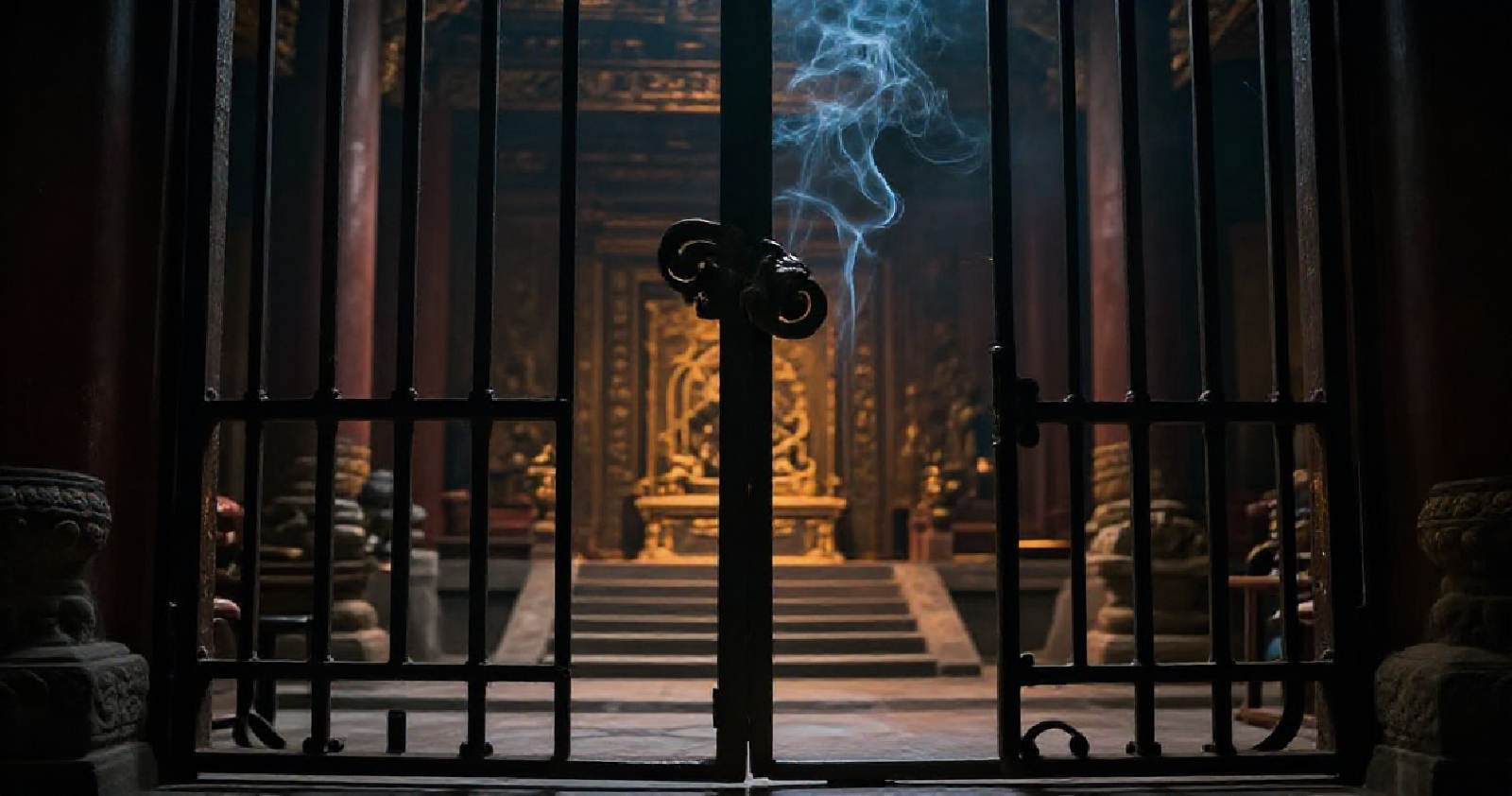
These are the gates of the official world. Most people spend the first half of their adult lives queuing before them. They do what they were told. They accumulate the correct credentials, perform the correct behaviors, cultivate relationships within the permitted channels — and they believe, somewhere beneath the calculation, that this sequence is reliable. That it is causal. That input leads to output in a predictable way.
And then the gates don’t open.
Or they open for someone else — someone whose credentials are inferior but whose uncle has a different kind of weight. Or they open for six months and then a policy shift closes them again without explanation. Or they simply never open at all, and no one in an official position will meet your eyes when you ask why.
What happens to a person at this moment? The intelligent ones — genuinely intelligent, not merely educated — do not conclude the universe is random. Randomness, oddly enough, is tolerable to a certain kind of mind. What is not tolerable is the feeling that you did everything right and it didn’t matter. The severing of the causal chain. The discovery that action no longer reliably predicts outcome.
This is the crack through which the metaphysical enters.
How many highly educated people do you know who privately consult fortune-tellers before a major business decision? How many executives arrange a feng shui consultation before signing a new office lease? How many PhD candidates visit a temple the night before their doctoral defense?
The official answer, if you ask them directly, is none of them. The actual answer is all of them.
I want to be precise here, because I have thought about this for years and I know the common diagnosis is wrong. When the official gates fail, people do not simply abandon causality. They refuse to abandon it — this is actually the healthy response. What they do is search for a different causal system. One that is not controlled by the gatekeepers who failed them.
If the human bureaucracy is corrupt and arbitrary, perhaps heaven is not. If the meritocracy is visibly rigged, perhaps the destiny framework (格局) written in a person’s chart is not. If the rule of men cannot be trusted, perhaps the patterns in time and chi fortune (气运) can be read without needing anyone’s permission.
When men close their gates and call it law, heaven opens its own doors and calls it fate.
This is not delusion. This is the human spirit insisting on order in the face of official chaos. And from where Master Chi sits — having watched thousands of people arrive at their lowest and most honest moments, and then having watched what happened to them afterward — I can tell you that this impulse is not the problem.
The problem is what people do once they cross the threshold.
A low-tier person arrives at the temple, burns incense, and waits. Having transferred their passive compliance from the official system to the divine one, they sit and hope that heaven will do what the government would not. When the answer doesn’t come, they burn more incense. When the incense doesn’t work, they look for a different temple, a more powerful deity, a more expensive practitioner. They have replaced one authority to obey with another. The passivity is unchanged. Only the address has changed.
A high-tier person arrives at the same metaphysical framework — and treats it as intelligence, not salvation. They read their major life cycle (大运) and ask: which years are favorable for expansion, and which for consolidation? They examine their life pattern and ask: what types of noble benefactors (贵人) are written into my chart, and through which kinds of channels will they appear? They understand that the metaphysical system, read with rigor, is a timing and alignment tool. Not a petition box to be stuffed with hope.
The difference is this: the low-tier person carries their passive dependency into the temple and sets it down at the altar. The high-tier person carries their strategic intelligence in and asks sharper questions than they’ve ever been permitted to ask inside an official setting.
This is why — and I have observed this without exception — the most serious students of destiny reading are disproportionately successful businesspeople. Not because the reading made them successful. Because people whose cognition is already adapted to processing non-obvious, long-horizon causal patterns will naturally seek more information about causation when the visible channels run dry. The temple is simply another data source for minds that were always running multiple models simultaneously.
Three years ago, a woman came to see me at a hotel in Shenzhen. She had flown in from Ningbo. Forty-six years old, ran a mid-sized chemical trading company she had built from scratch over fifteen years — starting with fifty thousand yuan borrowed from her husband’s family, growing to revenues that put her comfortably in the upper tier of private enterprise in her region.
She sat down across from me and said, before I could speak: “Master Chi, I don’t believe in any of this. I want you to know that. I have an MBA from Fudan and I have always thought this kind of thing was for uneducated people.”
I smiled. I have heard this opening perhaps a thousand times.
I said: tell me what happened.
What happened was fifteen years of a woman who believed in the logic of her system. Relationships cultivated carefully with the right local officials. Compliance maintained with precision. Expansion conducted through proper channels, every step documented. She believed — genuinely believed — in the predictability of the environment she had built. And the system had rewarded her for it.
Then a competitor arrived. Better connected at the provincial level. Within eighteen months, three of her key supply contracts had been transferred to this competitor through regulatory “adjustments” that had no basis in law but every basis in power. She filed complaints. She hired lawyers. She flew to Beijing twice. She called in fifteen years of favors from her official network. All of it produced polite acknowledgment and no movement.
The gate that had been open for fifteen years was closed. And there was no official mechanism for reopening it.
“I have tried everything,” she said. “I’m not here because I believe in you. I’m here because I have nothing left to try.” She paused. “I’m embarrassed to be sitting in this chair.”
I told her: you shouldn’t be. You’re here because you are still searching for causal logic. You haven’t given up on the idea that there is a pattern to this. That is not weakness. That is precisely the quality that built your company.
Then I read her BaZi.
What her chart showed was a woman with formidable structural strength — the kind of destiny that builds institutions, not just businesses. But her current major life cycle had placed her in a period of consolidation and invisible accumulation. Not expansion. Not combat. Her chart also showed something specific about the type of noble benefactors she was most likely to encounter: they would not come through regulatory channels or official introductions. They would come through lateral, personal connections — someone from entirely outside her industry, arriving through a domestic or social route she had never used professionally.
I told her: stop the lawsuit. Not because you’re wrong — you’re not wrong. But because you are fighting the right battle five years before you are positioned to win it. Redirect to a different segment. And pay serious attention to every personal introduction that comes through non-business channels in the next fourteen months.
She did it partially. Four more months of trying to prove she didn’t need to stop the lawsuit first. Then she stopped. Eighteen months after that session, I received a message through her assistant. A lateral partner had appeared — exactly the vector I had described. The new venture was generating margins her original business had never reached.
She didn’t call it BaZi. She called it “finally taking the timing advice.”
I wonder if any part of this sounds familiar to you.
Not the business specifics, perhaps. But the structure: you did everything correctly. You followed the sequence that was supposed to work. The sequence stopped working — not because of your failure, but because the system itself shifted beneath you in ways you couldn’t fully see or prevent.
And now you are standing before a gate that once opened for you, calculating whether to push harder, look for another gate, or accept that the gating logic itself has become unreliable.
Let me tell you something I do not often say directly.
Master Chi was once young and reckless and badly wrong about exactly this. When I was in my thirties, I went through a period where I stopped trusting my own readings. Not because my accuracy had declined — it had not. But because I had slowly, without noticing it, begun seeking the approval of other practitioners in my field before I trusted my own observations. I was consulting the professional consensus the way a bureaucrat consults policy documents — to protect myself from being wrong in an official way, rather than to see clearly. I had, in my own way, created an internal permission structure. And I was obeying it.
The readings suffered. And when counsel that should have helped a client does not help them, I feel that failure in a specific and unforgiving way. It took me two years to recognize what I had done, and another year to stop doing it. After that, I made a rule for myself that I have never broken since: I read what I see, not what I am permitted to see.
What failed you was not your intelligence. What failed you was not your effort. What failed you was your confidence in a system that was never quite as reliable as its architects claimed. The crack that has opened in that confidence is not a wound. It is a door — if you are willing to step through it correctly.
The people who step through it correctly do not abandon causality. They expand it. They learn to read chi fortune, to understand the patterns of timing that no official structure controls, to cultivate noble benefactors rather than institutional ones. They stop asking for permission and start reading the signals. They carry their intelligence into the temple the same way they carry it into a board meeting — actively, not hopefully.
The people who step through it incorrectly burn incense and wait. They find a new authority to obey rather than learning to see for themselves.
You have more intelligence than the second path requires. I have known this since before you read the first line of this article.
The universe does not owe you a functioning gate.
But it has never once stopped offering you signals.
Start reading them.